
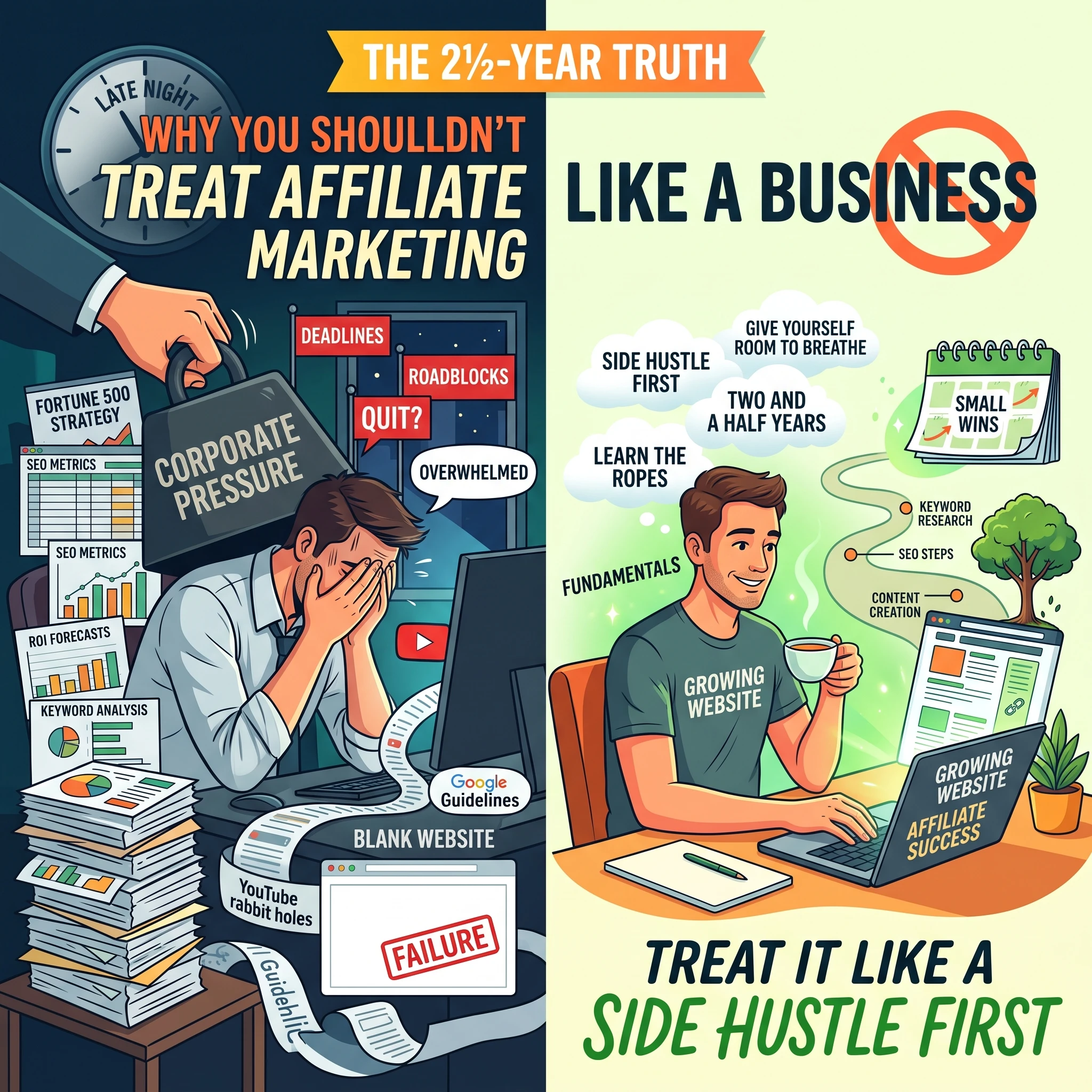
Why You Shouldn’t Treat Affiliate Marketing Like a Business
The 2½-Year Truth: The internet is full of “gurus” telling you to treat affiliate marketing like a Fortune 500 company on day one.
But when you’re dead tired from your 9-to-5, forcing that kind of corporate pressure onto a blank website isn’t ambition, it’s the fastest route to quitting.Treat it like a side hustle first, learn the ropes, and give yourself room to breathe.
In my two and a half years grinding through affiliate marketing, I’ve heard just about every piece of advice in the book.
The one that makes me cringe the most is the idea that you need to treat this like a full-scale online business from the moment you buy a domain.
If you already work a regular day job, that mindset puts way too much pressure on your shoulders.
You come home exhausted, stare at the laptop, and suddenly feel the weight of running an entire enterprise.
The learning curve is steep enough as it is.
You have to grasp the fundamentals, wrap your head around keyword research, and figure out how SEO actually works in the real world.
I know the trap intimately!
I spent my entire first year digging through Google guidelines, spiraling down YouTube rabbit holes, and signing up for every newsletter promising the “secret sauce.”
I was constantly chasing the next trick or the next hack to manipulate rankings.
When you treat this like a high-stakes business too early, every roadblock feels like a catastrophic failure.
You fight the process, end up completely overwhelmed, and throw in the towel before your site ever has a fighting chance.
The learning curve is steep enough as it is. You have to get comfortable with beginner affiliate terms, wrap your head around keyword research, and figure out how SEO actually works in the real world.
Key Takeaways
- Reject the “Day One Business” Myth: Approaching affiliate marketing as a heavy enterprise early on causes high friction and premature burnout, especially when juggling a 9-to-5.
- Embrace the Side Hustle Freedom: Treating your project as a side hustle removes performance panic, giving you the runway to master SEO basics and make mistakes safely.
- Choose Depth Over Output: Mass-producing 20 to 30 posts a month results in thin, unhelpful content; consistent, well-crafted pieces build lasting authority.
- Go Micro Before Going Wide: Starting narrow prevents your content from getting swallowed in search, making it far easier to gain early traction before expanding.
The “Day One Business” Myth (And Why It Sparks Burnout)
The standard playbook tells you that if you don’t treat your blog like a cutthroat business on day one, you aren’t taking it seriously.
That advice sounds good in a motivational soundbite, but it completely ignores real-world logistics.
Managing the 9-to-5 Cognitive Load
When you’re juggling a 40-hour workweek, your mental bandwidth is already stretched thin.
You spend eight hours solving problems for someone else, commute home, and then sit in front of a blinking cursor.
If you view that website as a full-fledged company, every hour away from the keyboard feels like lost revenue. Every minor technical hiccup feels like an operational disaster.
That mental weight turns what should be an exciting creative outlet into a second, higher-stress job.
By labeling it a side hustle early on, you change the psychology.
A side hustle gives you permission to experiment, make messy mistakes, and learn without the crushing expectation of immediate corporate performance.
The Cost of Chasing Guru Hacks
The second danger of the “business-first” mindset is the panic it creates.
When you feel the urgency of running an enterprise, you look for shortcuts to justify the stress.
I fell right into this during my first year. I wasn’t just writing; I was obsessively hunting for “loopholes.” I spent countless nights:
- Digging through dry search engine documentation trying to game the algorithm.
- Falling down YouTube rabbit holes that promised “rankings in 24 hours.”
- Signing up for every newsletter that claimed to have cracked the latest secret.
None of that built topical authority.
None of that connected with a reader.
It was just frantic busywork driven by the panic of trying to build a business overnight instead of patiently learning the craft.
Falling down endless YouTube rabbit holes and hunting for overnight shortcuts are classic affiliate marketing traps newbies fall into when they let panic drive the process.
Quality Over Quantity: The 30-Posts-a-Month Trap
Another piece of advice constantly thrown at beginners is that you have to publish every single day, cranking out 20 to 30 posts a month if you want any chance of ranking.
To someone who doesn’t even know what an H2 tag is yet, that isn’t just bad advice. It’s reckless!
Why High Volume Often Means Low Value
I’ve watched plenty of creators try to keep up with that relentless daily schedule. What actually happens? The content turns into pure garbage.
When your only goal is hitting an arbitrary publishing quota, you stop caring about whether the article actually solves a reader’s problem.
You cut corners, regurgitate surface-level fluff, and hit publish on content nobody wants to read.
Search engines don’t reward a mountain of uninspired text, and real human readers certainly won’t stick around or buy from your recommendations.
Fifty useless articles won’t do what two exceptionally well-researched, helpful pieces can.
Finding Your Sustainable Publishing Cadence
The winning formula isn’t churning out volume until your fingers bleed, it’s locking in a rhythm you can maintain week after week without losing your sanity.
When you’re building on the side:
- Focus on depth, not speed: Take the time to answer the exact question a searcher is asking.
- Learn the craft: Spend the extra hours understanding formatting, user intent, and natural keyword placement.
- Protect your energy: Publishing one or two solid, valuable pieces a week consistently will always beat a frantic 30-day blitz that ends in total exhaustion.
The Micro-Niche Strategy: Start Narrow, Expand Later
Early on, I was often told to cast a wide net: “Pick a broad topic, publish all over the place, and narrow down your focus once you see what catches on.”
In reality, the exact opposite approach is what actually moves the needle.
The “Pebble in the Ocean” Problem
When you launch a brand-new site and immediately try to cover a massive topic, your content gets swallowed whole.
It’s like tossing a tiny pebble into the middle of the Atlantic Ocean! No ripples, no impact, and nobody is ever going to see it.
Established authority sites have years of backlink profiles and topical history dominating those broad subjects.
If you jump into the deep end trying to compete across an entire broad category on day one, search engines won’t know what your site is truly about, and your posts will get lost in the noise.
When you launch a brand-new site and immediately try to compete in broad categories, or pick one of the worst blog niches that are already oversaturated, your content gets swallowed whole.
Dominating One Problem for One Specific Reader
Instead of going wide, start with laser focus. Pick a tight, razor-sharp pocket inside your niche and claim it.
- Target a single, specific reader: Solve one concrete problem for one defined person before trying to help the entire world.
- Build early topical traction: When you publish several tightly related posts around one micro-topic, search engines can easily connect the dots on your site’s focus.
- Earn the right to expand: Once you hit your stride, establish consistent ranking content, and truly understand your audience’s pain points, then you can widen your scope.
Starting narrow gives your early articles a fighting chance to get found, clicked, and trusted.
The Side Hustle Playbook: Protecting Your Longevity
Shifting your identity from a stressed-out “business owner” to a focused “side hustler” isn’t an excuse to be sloppy.
It’s a tactical defense mechanism designed to keep you in the game long enough to actually win.
1. Master the Fundamentals Without the Deadlines
When you aren’t sweating an arbitrary monthly revenue target, you give yourself room to master the mechanics that matter:
- True Keyword Intent: Learning how to find low-competition queries where real people are looking for genuine answers.
- On-Page SEO Basics: Understanding clean heading hierarchy, internal linking, and meta descriptions so your content is structurally sound.
- Persuasive Writing: Crafting honest, relatable copy that connects with a reader instead of sounding like a sterile sales pitch.
2. Strip Away the Overhead and Noise
A side hustle requires low friction.
You don’t need expensive rank trackers, enterprise keyword tools, or fancy graphic suites in your first six months.
Every dollar spent on unneeded software creates subconscious pressure to see an immediate return.
Keep your overhead near zero, stick to the essential tools, and invest your energy into the writing itself.
3. Build the Habit Before the Empire
Success in affiliate marketing is just the compounding interest of simple daily or weekly habits.
Give yourself permission to log an hour of quiet work after dinner, write half a draft on a Saturday morning, and refine your craft at a human pace.
The momentum builds when the process feels sustainable.
Final Thought: Staying in the 5%
The brutal statistic floating around this industry is that roughly 95% of online businesses end up failing.
They don’t fail because affiliate marketing is broken, or because the search landscape is impossible to crack.
They fail because the creators burn themselves out long before their hard work has time to compound.
They load themselves up with unrealistic expectations, try to run a corporate machine from an office desk after a grueling 9-to-5, and crash when the immediate payout doesn’t materialize.
If you want to be in the 5% that survives and wins, you have to protect your runway.
I’m not a guru sitting in an ivory tower claiming I have every answer.
I haven’t been doing this for decades.
I’m two and a half years deep into this journey, sitting right in the trenches with you, putting in the work and seeing the direct proof of what actually holds up.
- Take the unnecessary weight off your shoulders.
- Stop trying to run a multi-tiered business from day one.
- Treat this as a focused side hustle
- Zero in on a tight niche
- Obsess over quality rather than empty volume
- Let your consistency compound.
When you remove the panic, the craft becomes enjoyable. This is the only way you stay in the game long enough to see the real rewards.
Business vs Side-Hustle: FAQs
Why shouldn’t I treat affiliate marketing like a business immediately?
Treating it like a full-scale business places massive mental pressure and unrealistic revenue expectations on a beginner.
When balancing a 9-to-5, viewing your fledgling site as an enterprise turns your creative time into a stressful second job, which drastically increases your risk of burnout and quitting early.
How often should a beginner publish new articles?
Instead of chasing the guru myth of publishing daily or cranking out 20 to 30 low-quality posts a month, focus on a sustainable pace of one to two high-value, thoroughly researched articles per week.
Quality, search intent, and readability will always outperform empty volume.
Why is it better to start in a narrow niche rather than going broad?
Starting broad makes your content a tiny pebble in a massive ocean where established authority sites will easily drown you out.
Starting in a tight micro-niche lets you solve specific problems for a defined audience, which helps search engines understand your focus and rank your content faster.
When is the right time to transition from a side hustle to a business mindset?
You should only consider scaling into a formal business framework after you’ve dialed in your SEO fundamentals, established topical traction, and built a consistent audience and revenue stream that you understand inside and out.